
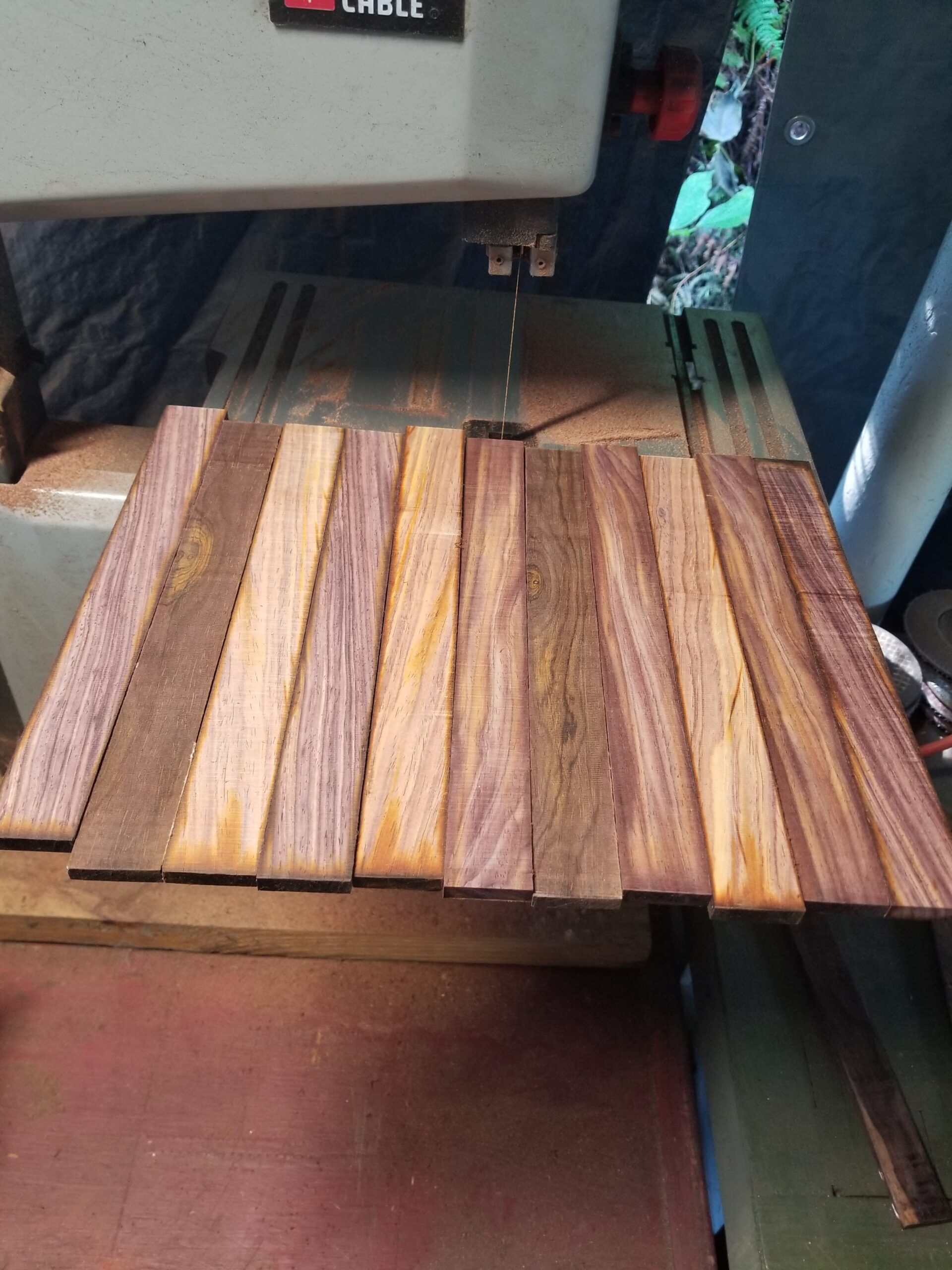
Wood: For the modern knife enthusiast or maker, there are so many materials that make good knife handles. Wood, bone, and horn are all natural and have a history of use dating from ancient antiquity to modern times. But modern times have produced many great options unavailable to the ancient smith, G10, various Micartas, stabilized woods and many more. They all can be beautiful and functional and I am glad they exist.
For me and my knives, wood has always been the material I feel most drawn toward. Not only is it a classic, but there are so many woods from around the world to choose from. I use domestic hardwoods from time to time, such as black walnut or curly maple. But I have always been a sucker for exotic hardwoods, and many of them, the ones that I use, are denser and more durable than almost all domestics.
Wood can come in colors ranging from any shade of brown to black, purple, yellow, pink and red. Figures can be anywhere from nonexistent to breathtakingly chaotic and dramatic. Woods keep me coming back again and again.
Wood is a natural material and as such there are certain realities that do not apply to a plastic like G10. My handles are sealed with Danish or Tung oil, nontoxic oils that will not evaporate and create a durable barrier to moisture. But wood will always be more susceptible to moisture then plastic and care should be taken to dry the knife off after it gets wets. Direct sun also has an impact on most woods, causing the grain to darken and figure to fade. Keeping the knife out of sustained, direct sun will go a long way towards preserving the color and figure. But time is undefeated and it is natural for some darkening to occur over time.
It is important to be aware of these realities. Working with a synthetic material has a lot of advantages to be sure, especially for mass production because wood is highly variable. But for me and the knives I make, by hand, wood is usually my first choice. Some things are classic for a reason and wood has a warmth and character that plastic cannot copy.
Bocote
Sometimes going by the misnomer Mexican Rosewood, Bocote is not truly in the rosewood family, though it shares some of the characteristics of being dense and resinous with a good natural luster. Featuring a yellowish or straw colored body with often chaotic and jumbled dark brown or black streaking. Texture is medium fine and uniform. Can vary significantly from piece to piece, but this wood is usually stunning and memorable.
Bocote is sustainably sourced from Mexico and Central America, from trees that grow 65’ to over 100’ tall.
Bocote is used primarily for its aesthetic properties, though it is still a durable and dense wood perfectly suited to knife handles. As is the case for most woods, with exposure to direct sunlight, the stark color contrasts can fade to a darker mottled brown. This can be slowed significantly by limiting time spent in direct sun, but color fade is an inevitable reality when working with woods.
This is one of my personal favorites to work with, cutting it open is such a treat, never knowing what exactly will be inside. But the surprise is always a pleasant one.
Fun fact: Bocote is known for smelling like dill pickles when it is being worked and sanded.
Wenge
Hailing from Central Africa, Wenge (pronounced When-gay), is an extremely hard and durable wood, cut out for the toughest duties. Usually medium brown with often dramatic darker brown or black streaks which can vary from subtle to dramatic. Sometimes with a yellowish or reddish hue. This extremely popular wood can vary from piece to piece in its coloration and contrast, but it is classic for a reason.
Grain tends to be straight with large pores. This does not take the silky smooth finish of some rosewoods, but it still takes a good natural luster and a highly durable finish.
Fun fact: Wenge is one of only a few woods in the world where exposure to sunlight actually increases the contrast between the lighter body and darker streaking, meaning that this wood ages beautifully, developing in character.
Ziricote
This wood is a rich medium to dark brown, sometimes exhibiting an olive or purple hue with black growth ring streaking. This is a hard and dense wood with a medium-fine texture resulting in a silky finish and good natural luster. Ziricote often has a unique, signature figuring called “spiderwebbing” or “landscaping” which is the result of the irregular black growth rings. There are few imitators, this wood can be really stunning.
Ziricote is sustainably sourced from Central America and southern Mexico. This is a premium wood, but still accessibly priced for small projects like knife handles.
Fun fact: Ziricote is prized by instrument makers for its acoustic properties.
Assorted Rosewoods
The Rosewood family is a big one and includes such notable members as cocobolo, kingwood, tulipwood and African Blackwood. Rosewoods can be anywhere from bright red and orange to purple to black. But as a general rule, rosewoods are dense, durable and resinous and take an excellent finish.
Rosewood imports and exports are strictly regulated wood and can be quite expensive. It is still legal to purchase rosewood, but supply is dubious.
An assorted rosewood handle would be made from one of the following, depending on availability: Hondruan rosewood, Nicaraguan, Madagascar rosewood or East Indian. Though each of these woods is unique, they share the common traits of a medium to dark brown body with darker streaking. Some have more reddish tones, others more purple or dark chocolate brown. But they are all beautiful and make for extraordinary handles.
Fun fact: there are over 300 members of the rosewood family, but only about a dozen of these woods have the vibrant hues and figure of the woods known commercially as “rosewood”.
Black Walnut
A classic domestic hardwood, black walnut is beloved for its rich coloration and durable properties. Heartwood ranges from light to dark brown with some occasional darker figuring. Generally straight grained with medium texture and a moderate luster. Though it is not as hard as many international hardwoods, black walnut is still strong and shock resistant.
Fun fact: in addition to producing beautiful wood and delicious nuts, the green husks that cover the black walnut’s fruit produce a dark brown dye that has been used for centuries to dye leather.
Maker’s Choice
A mystery wood from a wide selection of woods not generally available to order, depending on what is in stock. Possible woods include katalox, redheart, pau santo, olivewood, zebrawood, or spalted jatoba to name a few. All the woods are top quality and certain to be durable and beautiful.